
Find Who Owns a Fulton County Property in Three Checks
A solid answer to who owns a property in Fulton County rests on three checks. The assessment record locates the parcel. The latest deed proves the recorded transfer. The municipal roll adds a dated cross-check. Enter the address in Beacon or Image Mate. Confirm the situs and SBL. Note the displayed owner. Then search the Fulton County Clerk index. Look for the most recent deed touching that same land. This beats trusting a name from a general web search. A search engine may pin it on an address.
Address → assessment parcel → SBL → latest deed → owner conclusion.
Timing and names can trip you up. A deed recorded yesterday may be newer than an annual roll. An index hit can also belong to a different person with the same name. The SBL, legal description, and municipality keep your answer tied to the property itself. The recording sequence does the same job.
Use the Fulton Assessment Owner as a Lead
According to the Real Property Tax Service Agency, Beacon and Image Mate deliver ownership, inventory data, assessed values, photographs, and tax-map information, refreshed nightly. That owner display is the fastest public lead. Still, it lives inside the assessment system, not the deed record. Copy the name exactly, plus the mailing address, situs, municipality, SBL, and access date. The RPTSA property-record guidance walks through these county fields.
Follow that page's approach and you get a disciplined owner search. The parcel identifier travels with you into the deed record instead of stopping at a displayed name.
Confirm the Property Owner in Fulton County Deeds
SearchIQS hosts the modern County Clerk index. Search the assessment owner as grantee. Hunt for the newest deed whose municipality and legal description match the parcel. Then run that owner as grantor after the acquisition date. A later conveyance may surface. Online deeds and mortgages start September 1, 1983. Anything older lives in office indexes and deed books.
Read the vesting clause closely. Grantees may be spouses, several individuals, a trust, or an estate. They may also be a corporation, an LLC, a municipality, or another entity. A mailing recipient is not always a title holder. A person signing for an entity is not automatically the individual owner.
Interpret Fulton County Trust, Estate, and Business Ownership
A parcel card naming a trust sends you back to the deed. The deed holds the full trust name, trustees, and vesting language. For estates, WebSurrogate and Fulton County Surrogate's Court can identify the proceeding and the fiduciary. The Clerk's deed shows any recorded conveyance. Death certificates and genealogy records follow separate access rules and never substitute for land instruments.
Corporations and LLCs open another door. New York's Corporation and Business Entity Database returns the current entity name, formation date, jurisdiction, county, and service-of-process address. It also lists the registered agent, status, and some business fields. Those facts identify the entity. They do not prove an officer personally owns the real estate. Match the exact entity name to the deed before concluding anything.
Resolve Fulton Owner-Name Mismatches
Name mismatches across systems usually trace back to timing or purpose. A deed may have recorded after the roll date. An assessor may show an abbreviated entity name. Marriage, estate, trust, merger, or correction instruments can shift the indexing. A tax mailing address may belong to an agent. Compare the SBL and land description first. Then log the dates attached to each source.
| Mismatch | Next check | Likely explanation to test |
|---|---|---|
| Roll owner differs from latest deed | Recording and roll dates | Update timing |
| Business name is abbreviated | Deed and state entity search | Index display format |
| Estate appears | Surrogate file and later deed | Pending administration |
| SBL changed | Older rolls, maps, planning file | Split or combination |
Use Fulton Rolls to Date the Owner Display
The county posts assessment rolls by municipality. These include tentative and final files, with visible years back to at least 2016. Each roll preserves the owner display for one stated assessment cycle. That helps when you ask who appeared before or after a transfer. Gloversville and Johnstown calendars set the final roll on July 1. That date follows the May tentative roll and grievance period. The municipal roll archive supports that dated comparison.
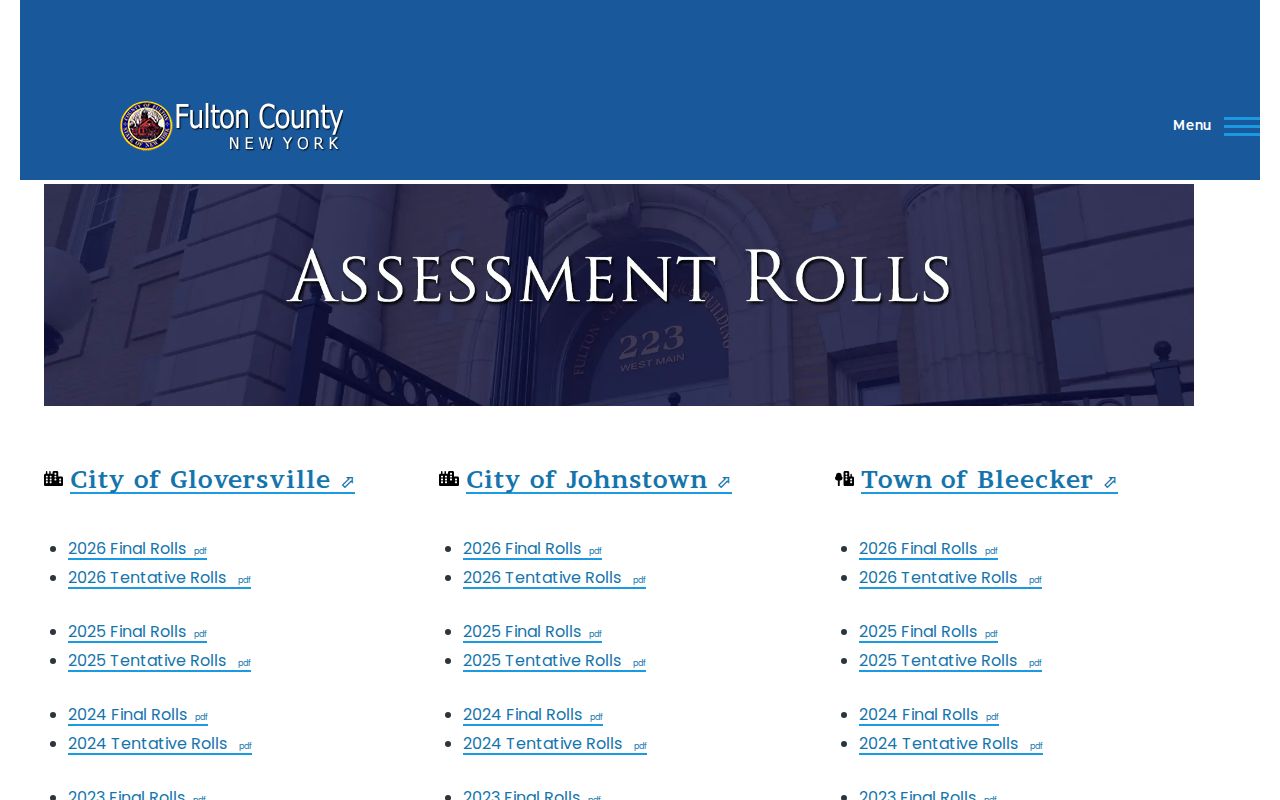
A run of roll years can show when an assessment owner changed. But the deed sequence remains the true record of recorded conveyances.
Check Fulton Owner Clues at City and Town Boundaries
A Johnstown mailing address can serve property in either the City or the Town of Johnstown, and ZIP 12095 covers both. Gloversville's 12078 also crosses the city line. Search the assessment municipality and SBL rather than letting the postal place pick your assessor, collector, or zoning office. The County Clerk stays the recording office countywide.
The distinction matters when two rolls hold similar street names or an address sits near a city edge. Confirm the municipal field in Beacon. Check the local zoning map where relevant. Keep the postal city separate from legal jurisdiction.
Know What “Property Owner” Means in Public Records
State your conclusion by source. Say "the final roll for this year displays X" or "the most recent matching deed found conveys to Y." Public records cannot tell you who occupies a home. Owner information should never be used to target or harass anyone. Address Confidentiality Program participants may use substitute addresses. Agencies must accept and protect them under New York law.
Owner of record is the owner shown in the official record. The grantee is the person who receives the deed. A mailing address is just where mail goes, not proof of residence. The situs is the property's physical location.
Use limitation. A public owner lookup supports property diligence and record research; it is not a title opinion and must never be used to stalk, harass, or harm a person.
Record the Fulton Owner Conclusion Without Overstating It
Report the Fulton County finding plainly. Cite the evidence. The final assessment roll shows one owner of record for a given year. The latest matching deed names its grantee and carries a recording date. If the two names differ, state the difference. Include both dates. Never infer residence, occupancy, family ties, or contact details from the mailing field. A purchase, inheritance, or title dispute calls for the recorded instrument itself, plus an abstract company or attorney. A public lookup cannot settle legal title. Keep the parcel number, SBL, municipality, source URL, and access date with your notes. That way another researcher can repeat the owner check and verify what the Fulton County property records show.