
Start Fulton County Deed Records with the Instrument Type
Labels matter in Fulton County deed records. A quitclaim, bargain-and-sale, executor's, or referee's deed can record a very different kind of event. The County Clerk also files mortgages, assignments, discharges, maps, liens, foreclosure filings, UCCs, and powers of attorney. Open the instrument. Never treat every indexed entry as an ordinary market sale.
| Instrument | What to inspect | What it does not settle alone |
|---|---|---|
| Deed | Grantor, grantee, date, consideration, legal description | Every title defect or off-record claim |
| Mortgage | Borrower, lender, amount, recording reference | Whether the debt remains open |
| Discharge | Mortgage reference and released party | Other liens |
| Map or plat | Lots, streets, dimensions, filing reference | A surveyed boundary on the ground |
| Lis pendens | Parties, court, property description | The final result of the case |
Search the Fulton County Clerk Index
The Fulton County Clerk keeps the land records. The office sits at the County Office Building, 223 West Main Street, Johnstown. SearchIQS provides the modern index online. Search a grantee to learn how an owner acquired property. Search that owner as a grantor to learn how it was conveyed away. Date ranges, document types, book/page references, and party-name variants all help narrow results. The index points to a record without reproducing every legal term. So always open or order the instrument before relying on a single line. The County Clerk's official page lists the land-record categories and the access route.
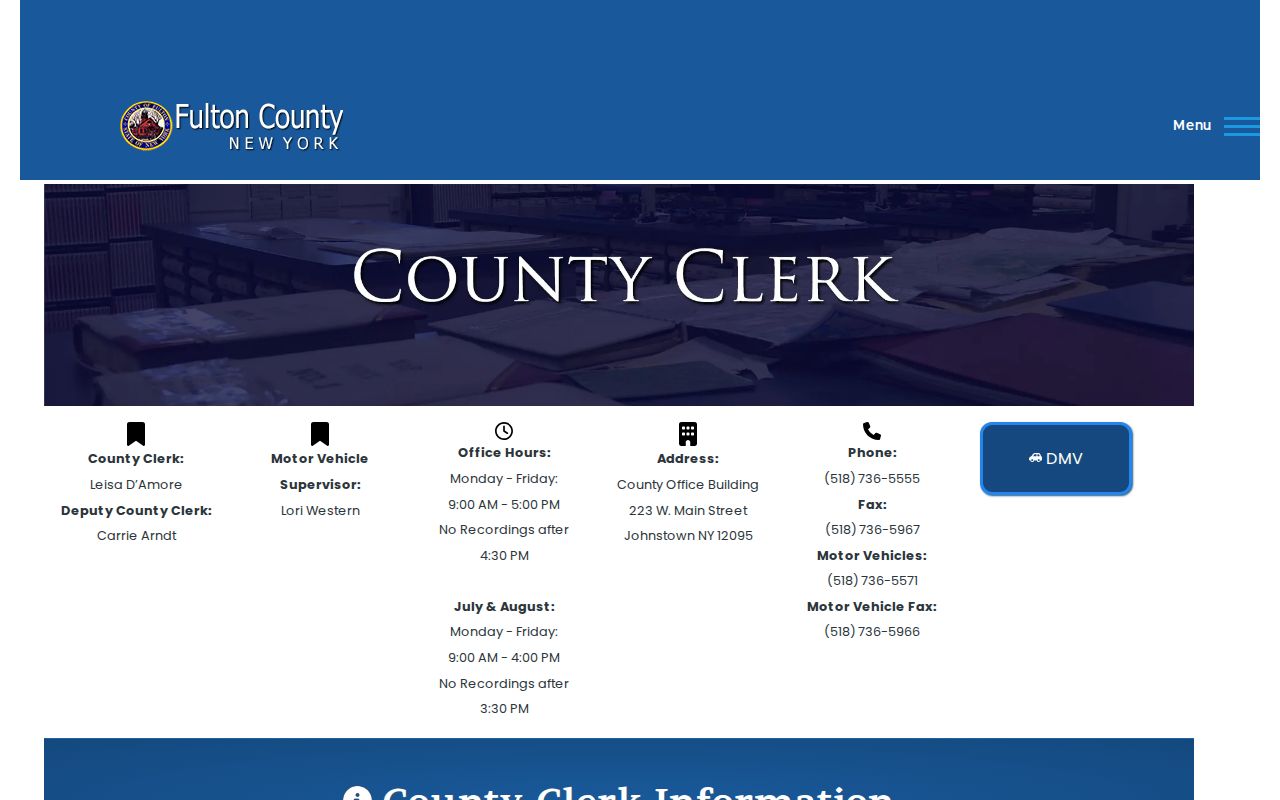
The office page links online searching to the custodian for older or certified material.
Understand Fulton County's Online Coverage Dates
The SearchIQS availability sheet covers deeds and mortgages. It sets September 1, 1983 as the online start for both. Mortgage discharges begin July 25, 2001. Lis pendens begin March 9, 2006 and judgments March 1, 2006. Federal tax liens, estate-tax releases, and UCC records start May 1, 2010. These cutoffs shape any Fulton County property search. An empty result before a date proves nothing. It does not show whether a paper deed, lien, or discharge exists.
Coverage limit. Continue a pre-1983 deed chain in the Clerk's deed books, microfilm, and office indexes; do not treat the online boundary as the historical boundary.
Write down the last online book/page first. Note party names and legal-description clues. The county historian and local history collections add context, but the recorded title instruments stay with the Clerk.
Read Grantor and Grantee Names as a Chain
The grantor gives an interest. The grantee takes it. To walk a chain backward, open the current deed and identify its grantor. Then search that name as a grantee in an earlier period. Record dates, instrument types, and book/page references as you go. Estates, trusts, business entities, marital changes, foreclosure referees, and tax proceedings can all break a surname chain. Search the exact legal entity and its variants. Then use the legal description and SBL to confirm each hit concerns the same land.
Grantor: conveying party. Grantee: receiving party. Vesting: how title is stated. Chain of title: linked recorded transfers for one property, while consideration: means the value stated in the instrument, which may not equal market value.
Reconcile a Deed with the Fulton SBL
Fulton assessment and map records use a section-block-lot number; 149.10-5-1 is a county example. A deed may instead rely on metes and bounds. Lot and map references, adjoining owners, roads, monuments, and earlier deed citations all appear too. The SBL locates the assessment parcel. It cannot replace the deed's legal description. Compare municipality, street, acreage, subdivision references, prior recordings, and adjoining features. The distinction matters after combinations or subdivisions. The Gloversville planning file for 342 South Kingsboro Avenue describes an assessment-combined parcel. It also describes a proposed two-lot division. Planning approval, a tax-map change, and a recorded deed can land on different dates. Check each one rather than assuming they align.
Follow Fulton Mortgages, Liens, and Releases
A deed shows who received a recorded interest. It does not list every later encumbrance. Search the Clerk index for mortgages, assignments, discharges, judgments, federal tax liens, UCC-related filings, and lis pendens under relevant parties and dates. Match each discharge to the mortgage recording reference it releases. A lis pendens signals litigation over real property but is not itself the judgment. Court portals such as WebCivil, NYSCEF guest search, and the local clerk can supply the case path when a docket matters. For an estate transfer, WebSurrogate and Fulton County Surrogate's Court can identify probate files and fiduciaries. The estate record explains authority or succession. The recorded deed documents the conveyance placed in the land records. Use both whenever the chain passes through a deceased owner of record.
Order a Fulton County Deed Copy with Precision
Give the Clerk precise details. Include the document type, grantor and grantee, recording date, book/page or instrument number, municipality, and property description. State whether an informational or certified copy is needed. A request for everything on an address is harder to fill. Land indexes historically center on parties and recorded references rather than modern street numbers. For an older chain, ask how the deed books, reverse indexes, or microfilm can be inspected. New York FOIL covers identifiable agency records. An initial response is generally due within five business days. It does not force an office to answer research questions or create a new record. Clerk schedules and statutory recording or copy fees may apply separately. Verify the current amount and accepted method with the office.
Put Historic Fulton Deeds in Local Context
Fulton County came into being in 1838, carved out of Montgomery County. That fact matters for deeds. Any search reaching back before that year leaves Fulton property records behind. It enters predecessor-jurisdiction territory, so older land documents sit in different archives. The Fulton County Historian handles questions like these. The office steers pre-1838 research toward the right sources. Nearby, the Gloversville Public Library local-history room keeps city directories back to the 1860s. It also holds atlases, cemetery records, newspapers, and microfilm. The Fulton County Historical Society holds directories, newspapers, and cemetery material too, available by research arrangement.
These resources explain old road names, past occupants, vanished businesses, and shifting neighborhoods. They cannot replace deeds. A directory entry or newspaper item is a clue, nothing more. Reconnect the historic address or name to a recorded deed description. Match it to a modern SBL parcel number before drawing conclusions about ownership or boundaries.
Know the Limits of Fulton County Deed Records
Recording a deed gives public notice of the instrument. It does not promise a complete title examination. Unrecorded interests, sloppy indexing, probate disputes, boundary fights, and errors in legal descriptions can all demand professional help. Tax-foreclosure auction pages state their limits plainly: properties go up for bid online, as is, by quitclaim deed, and every bidder carries the due-diligence burden alone. A quitclaim conveys only what the grantor actually holds. It never promises a clean title.
Title caution. Use Fulton County deed records for documented research, then use an abstract company or qualified attorney when a transaction or legal right depends on a complete title conclusion.